, fast delivery, and backed by our world-class customer service every step of the way.
 1-800-881-6093
 Back
What Is a Mailer Box? Types, Materials, Sizing and Cost
A mailer box is a one-piece corrugated box with an attached lid that folds over and tucks into the front. It ships on its own, with no outer carton, and it opens straight into your product, so it does the job of a shipping box and a presentation box at once. You will see mailer boxes everywhere in e-commerce: subscription kits, single-item orders, sample sets, and welcome packs. Unlike a bulk shipping carton built for pallets and warehouse handling, a mailer box is sized and printed for the person who opens it.
TL;DR:
- A mailer box is a roll-end tuck-front corrugated box (FEFCO 0427). It folds together without tape or glue and ships on its own.
- Packwire mailers are E-flute, 32 ECT, 200 lb test board. They hold around 40 lb and pass through USPS, UPS, FedEx and DHL without an outer box.
- Size from the inside: measure your product, add 1/8 to 1/4 inch per dimension, and check the result against dimensional weight before you commit.
- Pick white, kraft or SuperGloss board, print outside only or inside and out, and price it live in the 3D configurator.
- Custom mailer boxes start at $0.67 per unit at volume. The minimum run is 10 boxes, and a single printed sample is $35.
Table of Contents
- What a Mailer Box Does and Where You'll See It
- Mailer Box Types: Roll-End Tuck-Front, Tuck-End, Book Mailers, and More
- How Mailer Boxes Are Built: Corrugated Board, Fluting, and Wall Count
- Sizing Your Mailer Box: Measure, Add a Little, and Check Dimensional Weight
- How to Choose the Right Mailer Box: A Selection Checklist
- Branding and Printing Choices That Shape Cost and Impression
- How Packwire Handles Custom Mailer Box Orders
- Where Mailer Box Design Is Heading, and a Starting Point for Small Brands
- Start Your Custom Mailer Box Order
- FAQ
- Sources
What a Mailer Box Does and Where You'll See It
A mailer box has three jobs: protect the product in transit, present your brand the moment the lid comes up, and move through standard carrier networks without surcharges. That third job matters more than it sounds. A box that is oversized or awkwardly shaped raises your shipping cost before it ever reaches the unboxing moment, so function and presentation work together rather than against each other.
You will run into mailer boxes most often in three contexts:
- Subscription boxes: monthly beauty, snack, or hobby kits that need consistent branding across repeat shipments
- Single-item DTC orders: apparel, accessories, skincare, or small electronics sold directly from your online store
- Welcome and sample kits: onboarding packs, PR drops, and promo kits where the box is part of the message
The balance you are managing is simple to state and harder to execute: enough structure to survive a conveyor belt and a delivery van, with enough visual impact that the unboxing feels intentional. Get the sizing wrong in either direction and you either under-protect the product or overpay to ship air.
Mailer Box Types: Roll-End Tuck-Front, Tuck-End, Book Mailers, and More
Most mailer boxes fall into a handful of recognizable constructions. Picking the right one comes down to how the product gets handled, how often the box gets opened, and how much weight it needs to carry.
- Roll-end tuck-front mailers (REFT, FEFCO 0427): the box most people mean when they say "mailer box." The side walls roll over to form double-thickness walls, the lid hinges from the back, and a front tab tucks into a slot. Strong at the corners, assembles in seconds with no tape or glue, and opens flat for a full-width reveal. This is the style Packwire makes.
- Roll-end top-tuck (RETT): the same roll-end body with the tuck on top instead of the front. Some subscription brands add a tear strip for a one-time opening.
- Tuck-end boxes: a lighter paperboard or corrugated box with flaps that tuck in at both ends. Fine for apparel and small accessories inside another carton, but not a box you would ship on its own.
- Book and literature mailers: low-profile, rigid-cornered boxes that keep flat items like books, magazines, or printed materials from bending in transit.
If your product is flat and rigid, a book mailer protects the corners without adding bulk. If it is soft goods or a boxed item, a roll-end tuck-front mailer keeps costs down because the product absorbs minor impacts and the box handles the rest. Fragile items usually need an insert or void fill inside the mailer rather than a heavier box, a point worth remembering before you lock in a style.
How Mailer Boxes Are Built: Corrugated Board, Fluting, and Wall Count
Mailer boxes are made from corrugated fiberboard, not plain paperboard. Corrugated board gets its rigidity from a layered structure: flat liner sheets on the outside with a fluted, wavy layer glued between them. That fluting is what gives corrugated its strength-to-weight advantage over the single-layer paperboard used for cereal boxes and folding cartons.
Wall count changes what a box can handle. Single wall, one fluted layer between two liners, is the standard for mailer boxes and handles typical DTC weights. Packwire mailers use single-wall E-flute, about 1/16 inch thick, rated 32 ECT (200 lb test), which carries around 40 lb per box. Double wall adds a second fluted layer for heavier or bulkier items and is available on request. Triple wall is reserved for industrial shipping rather than direct-to-consumer mailers.

Industry style codes keep specifications consistent across suppliers. FEFCO's design library assigns numeric codes to each construction: 0427 is the roll-end tuck-front mailer, and 0201 is the regular slotted shipping box with four top flaps. Quoting the code removes any ambiguity about which box you mean. ASTM D5118 sets the broader fabrication practice manufacturers reference for fiberboard quality and construction. For board grades and what they hold, see our Packaging Board Chart.
Sizing Your Mailer Box: Measure, Add a Little, and Check Dimensional Weight
Getting the size right protects your product and keeps shipping costs predictable, because carriers bill on dimensional weight as often as actual weight.
- Measure your product at its longest points: length, width, and height, including any protrusions like a pump, a zipper pull, or a lid.
- Add 1/8 to 1/4 inch to each dimension. That gives a snug fit with room for tissue or a thin insert. A box that is too tight stresses the walls; one that is too loose lets the product shift. If you are adding crinkle paper or a thick insert, size for the filled box, not the bare product.
- Order by inside dimensions. All Packwire box sizes are interior measurements, listed as length by width by depth, so the number you enter is the space your product gets. The outside is slightly larger because of board thickness, and that outside size is what carriers measure.
- Check the dimensional weight before you commit. Run the outside dimensions through our Dimensional Weight Calculator. If you are a fraction of an inch over a billing threshold, trimming the box is cheaper than paying for it on every shipment. The Box Size Optimizer finds the smallest box for a set of products.
Our mailer box sizing guide walks through dimension charts for common product categories if you are sizing something less typical.
How to Choose the Right Mailer Box: A Selection Checklist
Choosing a mailer box is really five smaller decisions happening at once: how fragile the product is, what the box will cost to ship, how much branding you want on it, how fast you need it, and whether sustainability matters to your customers.
- Match construction to fragility and weight: single-wall E-flute for typical DTC items up to around 40 lb; ask about double wall for anything heavier or prone to shifting in transit
- Watch dimensional weight, because carriers charge on box volume as often as actual weight, so an oversized box costs more even when it is mostly empty
- Decide your print coverage early: on a mailer, the share of the box your artwork covers moves the price, and any print inside the lid makes it a two-sided job
- Know the minimums and lead time before you plan a launch: Packwire's minimum is 10 mailers, production runs 10 to 20 calendar days after proof approval, and a single printed sample is $35 if you want to hold one first
- Consider recycled content and recyclability if sustainability is part of your brand story, since interest in sustainable packaging continues to grow among both consumers and sellers. Packwire corrugated boxes contain at least 50% recycled content and are curbside recyclable.
Pro Tip: Order a physical sample before committing to a full run. A rendering on screen rarely shows how a board finish or a color reads in hand, and a sample costs less than one wrong case of boxes.
If you are deciding between a mailer and a heavier-duty shipping carton, our comparison of mailer boxes and shipping boxes breaks down which fits which use case.
Branding and Printing Choices That Shape Cost and Impression
Print method is usually the first fork in the road. Digital printing goes straight onto the corrugated board with UV-cured inks, with no plates or dies, which is what makes a 10-box run realistic and lets you change the design between orders at no cost. Above a few thousand units, HD flexo or litho lamination can bring the unit price down further, and Packwire quotes those by request.
Board choice layers on top of that decision:
- White board is white on both sides with a matte surface. The default for accurate, clean color on skincare, wellness, and apparel brands
- Kraft board is brown on both sides. Colors print more muted, and the natural texture signals sustainability and craft
- SuperGloss board has a smooth, glossy coating that makes colors richer and photographs well for unboxing content
All three boards are the same thickness, so the choice is about look, not strength. Selective varnish and other finishes are available on request depending on quantity.
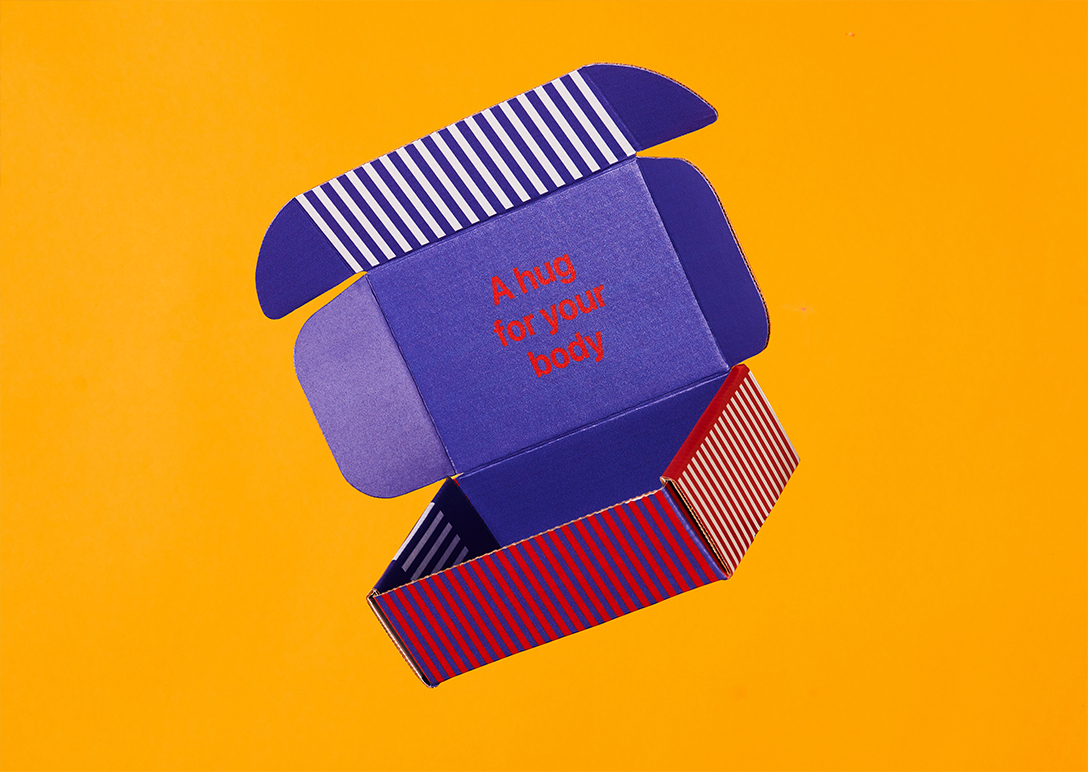
Inside printing is where mailers earn their keep. A message, pattern, or color inside the lid is the first thing your customer sees, and Packwire prints the inside of any mailer. One thing to budget for: any artwork inside, even a small logo under the lid, makes the box two-sided, which prices higher than outside print alone. Custom corrugated inserts (minimum 500 units) hold products in place and turn a plain box into something worth photographing. Our guide to designing mailer boxes that look like a real brand walks through how these choices work together without inflating cost.
How Packwire Handles Custom Mailer Box Orders
Every Packwire mailer starts in the 3D configurator. You enter your inside dimensions, anything from 2 x 2 x 2 inches up to 20 x 20 x 6 inches, pick a board, upload your artwork, and see the price update live as you change quantity and coverage. There is no stock-size list to fit your product into, and a custom size costs nothing extra and adds no lead time, because the box is cut on a digital table rather than with a metal die.
After checkout, your account manager sends a 2D proof by email and checks the artwork for resolution, bleed, and color. Revisions are unlimited and free, and production only starts once you approve the proof. From there, plan on 10 to 20 calendar days of production and about a week in transit, so two to four weeks door to door. Mailers ship flat and fold together on your end with no tape or glue.
If you want to see your own artwork on a real box before ordering a run, set the quantity to 1 in the configurator. A single printed sample is $35 plus $6.25 shipping in the continental US.
Where Mailer Box Design Is Heading, and a Starting Point for Small Brands
Unboxing has become part of the product rather than an afterthought, and sustainability expectations are rising alongside it. Buyers increasingly notice recycled content and recyclable construction, not just printed logos.
If you are a small brand testing this for the first time, resist the urge to redesign your entire packaging line at once. Pick a single SKU, order one printed sample, ship it to yourself, and see how it arrives before scaling the design across your catalog. Our notes on packaging trends cover what is driving this shift in more detail.
Start Your Custom Mailer Box Order
Testing a custom mailer box does not require a warehouse-sized order or a design team. The 3D configurator lets you size, design, and price a box in one session, and the 10-box minimum makes a first run realistic for a small catalog.
Two paths work well depending on where you are: configure a sample box to see your artwork on a real mailer, or request a quote if you already know your dimensions and need more than the configurator's 2,000-unit ceiling. Either way, your artwork is reviewed and proofed before anything prints.
Start on our custom mailer boxes page to size your first box and see real pricing.
FAQ
Quick answers to the questions people ask most often about mailer boxes.
What is the difference between a mailer box and a shipping box?
A mailer box is a one-piece corrugated box with a hinged lid that tucks closed, built to ship on its own and open straight into the product. A shipping box is the classic carton with four flaps on top and bottom that you seal with tape. Shipping boxes use the same board but hold more, around 60 lb against a mailer's 40 lb, so they suit heavier products and multi-item orders. Both can be printed. See our mailer box versus shipping box comparison for the full breakdown.
How much does a mailer box cost?
Pricing depends on size, board, print coverage, and quantity. Packwire custom mailer boxes start at $0.67 per unit at volume, and the price per box drops at every quantity tier. A single printed sample is $35. Finishes and custom inserts add to the base price.
What are the different types of mailer boxes?
The common styles are roll-end tuck-front (REFT) and roll-end top-tuck (RETT) mailers, tuck-end boxes, and book or literature mailers. REFT is the standard e-commerce mailer and the style Packwire makes: strong rolled side walls, a hinged lid, and a front tuck that needs no tape.
What are the three types of boxes?
Most custom packaging falls into three families by material: corrugated boxes (mailers and shipping boxes) for anything that ships, folding cartons made from paperboard for retail product packaging, and rigid boxes with a thick, non-folding board for premium presentation. Packwire makes all three. Folding cartons and rigid boxes are not built to ship on their own, so they usually travel inside a mailer or shipping box.
Sources
- D5118/D5118M Standard Practice for Fabrication of Fiberboard Shipping Boxes
- Corrugated board production | FEFCO