 , fast delivery, and backed by our world-class customer service every step of the way.
  1-800-881-6093
 Back
Back
Corrugated Flute Types: A Technical Guide for Packaging
Choose B-flute for general-purpose shipping, E or F-flute when print fidelity and retail presentation are the priority, and double-wall or A-flute when maximum cushioning or stacking strength is required. That single sentence covers the majority of real-world flute decisions. The five standard corrugated flute types (A, B, C, E, and F) each occupy a specific performance band, and picking the wrong one costs you either in damaged product, inflated freight bills, or a printed box that looks nothing like your brand intended.
Here is a quick-reference matrix before the full breakdown:
- General shipping cases (parcel or pallet): B-flute single-wall, 32–44 ECT
- Premium DTC mailers and retail-ready boxes: E-flute or F-flute, digital print
- Fragile or heavier items (5 lbs+), puncture risk: C-flute or BC double-wall
- Heavy industrial or machinery shipping: A-flute or triple-wall constructions
The biggest trade-offs to keep in mind as you read:
- Cushioning vs. printability: Larger flutes absorb shock better; smaller, denser flutes give you a smoother print surface.
- Caliper vs. DIM weight: Thicker boards protect more but increase your external dimensions, which raises dimensional weight charges on parcel carriers.
- Flute profile vs. ECT: The flute name alone does not certify stacking performance. The Edge Crush Test (ECT) rating of the finished board does.
- Automated handling: Many case erector lines are tuned for standard C-flute single-wall; switching caliper affects scoring, run speed, and tooling.
Key Takeaways
Flute selection is a structural decision first and a print decision second. Get the ECT and caliper right for your transit profile, then optimize the surface for your brand.
| Point | Details |
|---|---|
| Match flute to transit risk | B-flute at 32–44 ECT covers most parcel shipping; move to C-flute or BC double-wall for heavier or fragile items. |
| E-flute leads for DTC print | E-flute (1/16 in nominal, ~1.6 mm, ~90 flutes/ft) gives the smoothest corrugated print surface and the lowest DIM weight for lightweight mailers. |
| ECT certifies stacking strength | Flute name alone does not guarantee stacking performance; always specify the ECT rating alongside the flute profile. |
| Liner grade drives color fidelity | Upgrading to a white-top or clay-coated liner on the same flute profile often improves print quality more than switching flute profiles. |
| Packwire for custom corrugated | Packwire offers custom printed corrugated boxes with artwork review, low minimums, and a 3D configurator at Packwire. |
Table of Contents
- What are corrugated flute types and how do they work?
- The five corrugated flute profiles: specs, strengths, and best uses
- How do the five flute profiles compare at a glance?
- How does board construction change what a flute can do?
- How do you choose the right flute for your product?
- How does flute choice affect custom printed corrugated boxes?
- Authoritative standards and resources for deeper reading
- Where flute specs go wrong in production
- Custom corrugated boxes with print quality built in
- Sources
What are corrugated flute types and how do they work?
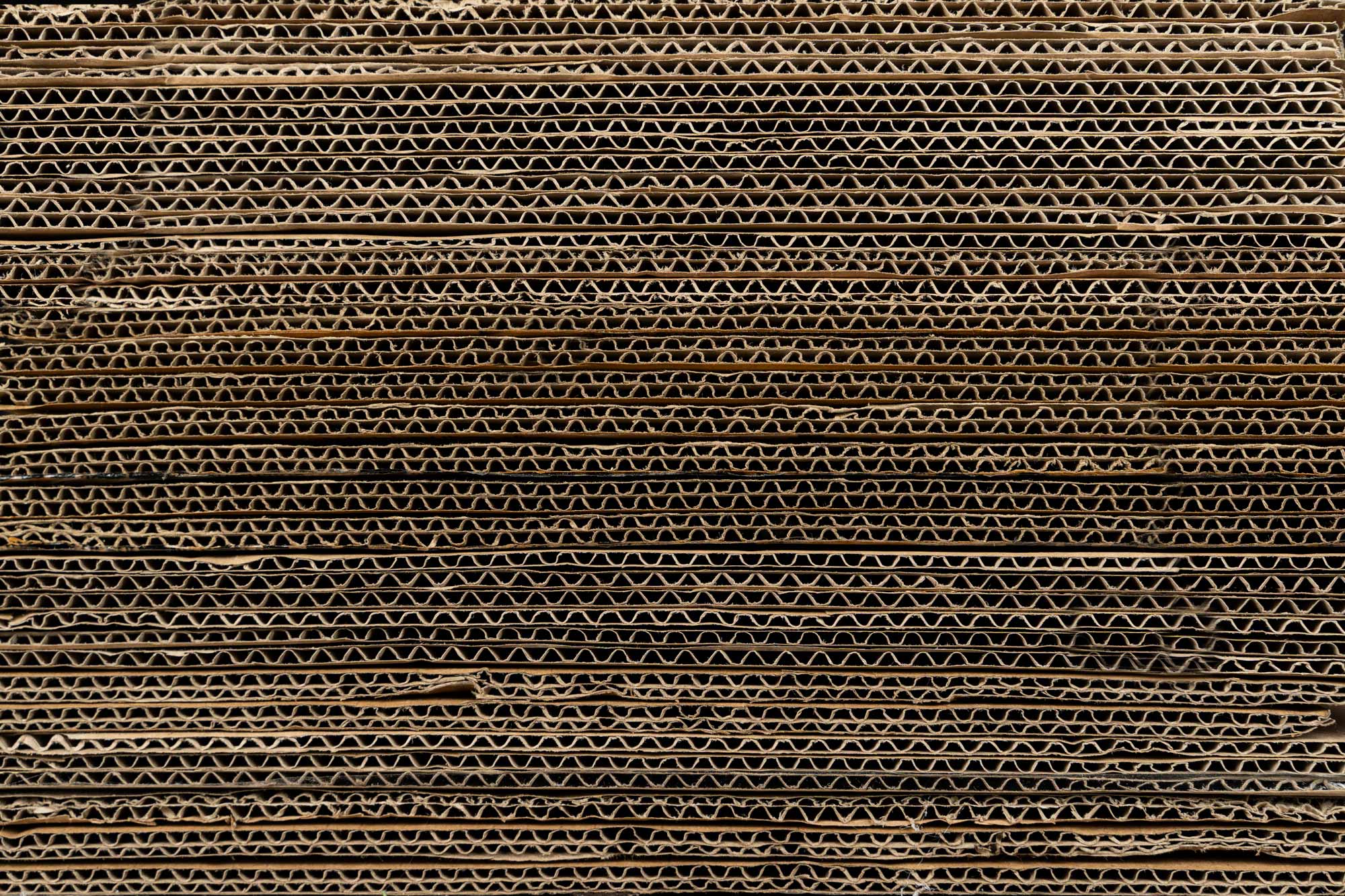
A flute is the S-shaped wave of paper (the corrugated medium) that runs between two flat sheets called liners. That wave is what gives corrugated board its structural properties. Change the wave's height or frequency, and you change how the board performs under compression, impact, and print pressure.
Four geometric variables control everything:
- Flute height (caliper): The distance from the bottom liner to the top of the wave crest. Taller flutes create more air space, which translates to better cushioning and stiffness. Shorter flutes compress the wave, producing a denser, smoother surface.
- Flute pitch: The distance from one crest to the next. Pitch determines how many flutes fit per linear foot, a figure you will see cited as "flutes/ft" throughout specs and supplier data sheets.
- Crest and valley geometry: The precise arc shape at each crest and valley affects how the board responds to flat crush (pressure applied perpendicular to the liner face) versus edge crush (pressure applied to the cut edge).
- Liner grade: The weight and quality of the facing sheets interact with flute geometry to determine final board stiffness, moisture resistance, and print smoothness. Liner grade is a separate variable, but it amplifies or limits whatever the flute profile contributes.
A short glossary of terms you will encounter when reading supplier specs or ordering board:
- ECT (Edge Crush Test): Measures the board's resistance to compressive force applied to its cut edge, expressed in lbs/in. This is the primary stacking-strength certification for corrugated cases in the U.S.
- Flat crush: Resistance to compression applied perpendicular to the liner face, relevant for boards that will be stacked horizontally or run through printing nips.
- Caliper: The total thickness of the finished board, measured in inches or millimeters. Caliper is influenced by both flute height and liner thickness.
- TC/CC (top crush / corner crush): Secondary compression tests used to evaluate how a finished box performs under real stacking loads, particularly at corners.
One practical note on tolerances: the flute height and flutes-per-foot figures you see in spec tables are industry-typical values, not hard absolutes. Flute height is the single most critical variable for board stiffness and cushioning, but actual dimensions vary by mill, liner grade, and manufacturing conditions. Always request a physical sample and confirm caliper with your supplier before finalizing a spec.
The five corrugated flute profiles: specs, strengths, and best uses
Each flute profile occupies a distinct performance band. The specs below reflect industry-standard flute counts and heights as summarized by the Fibre Box Association; actual mill output varies within a tolerance range.
One convention to know before you read the numbers: board is ordered by its nominal fraction (quarter-inch A, eighth-inch B, sixteenth-inch E), but a caliper gauge reads lower than the fraction implies, because the nominal designation rounds up. B, E, and F land within a few hundredths of their fraction. A and C run noticeably under theirs. Both figures are listed below so you can order in the trade shorthand and still know what your gauge should show.
A-flute: maximum cushioning
| Spec | Typical value |
|---|---|
| Flute height | 4.7 mm (0.185 in) |
| Flutes per linear foot | ~33 flutes per foot |
| Board caliper (single-wall) | 1/4 in nominal (4.8–5.2 mm / 0.19–0.20 in measured) |
| Typical single-wall ECT | 26–44 lbs/in (set by liner grade, not flute profile) |
A-flute is the tallest standard profile, which gives it the most air space and the best cushioning per layer. It also has the highest stiffness-to-weight ratio among single-wall constructions, making it a solid choice for fragile items that need protection from vertical shock.
Strengths: Superior cushioning, excellent vertical compression resistance, good stiffness for its weight.
Weaknesses: Bulky caliper increases DIM weight; not ideal for high-resolution print; takes up more warehouse space per unit.
Best for: Glassware, ceramics, electronics with internal cushioning requirements, produce and perishable goods, and any application where the box itself needs to absorb drop impact without an inner foam insert.
B-flute: puncture resistance and print-friendly
| Spec | Typical value |
|---|---|
| Flute height | 2.5 mm (0.098 in) |
| Flutes per linear foot | ~47 flutes per foot |
| Board caliper (single-wall) | 1/8 in nominal (3.0–3.2 mm / 0.12–0.13 in measured) |
| Typical single-wall ECT | 26–48 lbs/in (set by liner grade, not flute profile) |
B-flute packs more flutes per foot than A or C, which creates a denser, more puncture-resistant surface. That density also makes it one of the better single-wall profiles for flexo printing, since the tighter wave produces less surface variation than A-flute. B-flute at approximately 3.0 mm gives superior crush resistance for heavier or fragile items and increases DIM weight compared to E-flute, a real consideration for parcel shippers.
Strengths: Good puncture resistance, decent print surface, lower caliper than A-flute, handles die-cutting well.
Weaknesses: Less cushioning than A-flute; still adds meaningful caliper compared to E-flute, which affects DIM weight.
Best for: Canned goods, bottled products, point-of-purchase displays, pizza boxes, and retail shelf-ready packaging where puncture resistance matters more than maximum cushioning.
C-flute: the all-purpose shipping standard
| Spec | Typical value |
|---|---|
| Flute height | 3.6 mm (0.142 in) |
| Flutes per linear foot | ~38–39 flutes per foot |
| Board caliper (single-wall) | 3/16 in nominal (3.8–4.1 mm / 0.15–0.16 in measured) |
| Typical single-wall ECT | 29–55 lbs/in (set by liner grade, not flute profile) |
C-flute is the most widely used profile in North American shipping. It sits between A and B on both cushioning and print surface, which is exactly why it became the default. Single-wall C-flute at 32 ECT is the common baseline for case erector lines, with 44 ECT used for heavier runs. If you are shipping a general consumer product and have no strong reason to deviate, C-flute is the rational starting point.
Strengths: Balanced cushioning and stacking strength, widely available, compatible with most automated packing equipment, cost-effective at volume.
Weaknesses: Not the best choice for premium print applications; caliper is higher than E-flute, which matters for DIM-weight-sensitive parcel programs.
Best for: General e-commerce shipping cases, grocery and food service, appliances, and any product that needs reliable transit protection without a premium print requirement.
E-flute: the premium print profile
| Spec | Typical value |
|---|---|
| Flute height | 1.2 mm (0.047 in) |
| Flutes per linear foot | ~90 flutes per foot |
| Board caliper (single-wall) | 1/16 in nominal (1.5–1.6 mm / 0.06 in measured) |
| Typical single-wall ECT | 26–32 lbs/in (set by liner grade, not flute profile) |
E-flute is a microflute. Its tight wave pattern produces a surface that approaches the smoothness of folding carton, which is why it dominates premium retail packaging and DTC mailer boxes. E-flute at approximately 1.5 mm is the standard for high-fidelity printed mailers and lightweight DTC goods. The trade-off is structural: E-flute has less cushioning than B or C, and it is not the right choice once your product weight or fragility pushes past the range it can handle.
For e-commerce brands, E-flute strikes a balance of print quality and lower dimensional weight, while B-flute becomes the safer call once product weight or fragility exceeds E-flute's range.
Strengths: Excellent print surface for digital and high-quality flexo, low caliper reduces DIM weight, die-cuts cleanly for complex retail structures.
Weaknesses: Lower cushioning and stacking strength than B or C; not suited for heavy or fragile items without additional internal packaging.
Best for: Cosmetics, apparel, subscription boxes, lightweight electronics accessories, retail shelf packaging, and any DTC mailer where unboxing experience and brand presentation are primary goals. Packwire's custom mailer boxes are commonly produced in E-flute for exactly this reason.
F-flute: the finest microflute
| Spec | Typical value |
|---|---|
| Flute height | 0.75 mm (0.030 in) |
| Flutes per linear foot | ~125–128 flutes per foot |
| Board caliper (single-wall) | 1/32 in nominal (0.8–1.0 mm / 0.03–0.04 in measured) |
| Typical single-wall ECT | 23–26 lbs/in where rated; often specified by caliper instead |
F-flute is the finest standard corrugated profile, sitting at the boundary between corrugated board and folding carton. Its near-flat surface supports the sharpest graphic reproduction available in corrugated, and its thin caliper makes it practical for retail packaging where shelf space and pack-out density matter. The structural trade-offs are significant: F-flute is not a shipping board for anything heavier than a lightweight retail item.
Strengths: Closest to folding-carton print quality, minimal caliper, excellent die-cut detail for intricate retail structures.
Weaknesses: Low structural strength, limited cushioning, not suitable for transit without an outer shipping case.
Best for: Premium cosmetic boxes, confectionery, jewelry packaging, point-of-sale displays, and any retail application where graphic fidelity and thin-wall construction are more important than transit durability.
How do the five flute profiles compare at a glance?
The table below consolidates the key decision dimensions, ordered thickest to thinnest so the cushioning-to-print-quality gradient reads in one pass. Values are industry-typical; confirm with your supplier before finalizing a spec.
| Flute | Board caliper (single-wall) | Flutes/ft | Cushioning | Print surface | Best use |
|---|---|---|---|---|---|
| A | 1/4 in nominal (4.8–5.2 mm) | ~33 | Highest | Poor | Fragile and shock-sensitive goods, heavy industrial |
| C | 3/16 in nominal (3.8–4.1 mm) | ~38–39 | High | Fair | General shipping cases, the North American default |
| B | 1/8 in nominal (3.0–3.2 mm) | ~47 | Moderate | Good | Puncture resistance, shelf-ready retail, POP displays |
| E | 1/16 in nominal (1.5–1.6 mm) | ~90 | Low | Very good | DTC mailers and premium retail where print leads |
| F | 1/32 in nominal (0.8–1.0 mm) | ~125–128 | Minimal | Best | Cosmetics, jewelry, POS; never a shipping board |
The Fibre Box Association confirms that larger flute profiles increase vertical compression strength and cushioning while smaller, denser flutes improve print smoothness and graphic fidelity, a trade-off that holds consistently across mill output and liner grades.
One important clarification on measurement variance: the heights and flutes-per-foot figures above are typical, not absolute. Liner grade, adhesive application, and manufacturing tolerances all shift the final caliper. Two boards labeled "C-flute" from different mills can differ by 0.5 mm in caliper, which affects both stacking performance and how the board runs on your equipment. ECT, not flute name alone, is the spec that certifies stacking performance for a given board construction. When you need a stacking guarantee, specify the ECT rating alongside the flute profile. For formal test method standards, the ISO Online Browsing Platform is the authoritative place to locate published packaging material testing standards.
How does board construction change what a flute can do?
Flute profile is only half the story. The number of liner-medium-liner layers you combine determines the board's final performance envelope.
Single-wall: One corrugated medium between two liners. This is the standard construction for most retail and parcel shipping applications. C-flute single-wall handles the majority of consumer goods shipments. E-flute single-wall covers most premium DTC mailers.
Double-wall: Two corrugated mediums and three liners. Combining two flute profiles in one board multiplies thickness, puncture resistance, and stacking strength without requiring a heavier single flute. Common pairings:
- BC double-wall: B-flute outer layer + C-flute inner layer. The workhorse for industrial shipping, heavy retail pallets, and appliances. You get C-flute's cushioning depth plus B-flute's puncture resistance on the outer face.
- EB double-wall: E-flute outer + B-flute inner. A strong choice for heavy retail displays or DTC products that need a printable outer face with meaningful structural support underneath.
- AC double-wall: A-flute + C-flute. Used when maximum cushioning depth is required, such as for fragile industrial components or large appliances.
Triple-wall: Three corrugated mediums and four liners. This construction approaches the strength of light plywood and is used for machinery crating, bulk bins, and export packaging where the box itself is a structural element. Weight and cost are significant, so triple-wall is reserved for applications where no lighter construction passes compression and drop testing.
The mechanical logic of combining flutes is straightforward: each additional medium layer adds thickness (which increases bending stiffness), puncture resistance, and edge crush performance. The trade-offs are added weight, higher material cost, and reduced flexibility on automated equipment. Many case erectors and packing lines are calibrated for standard C-flute single-wall; running double-wall board through the same line often requires tooling adjustments and slower run speeds.
When you are deciding between a thicker flute and a double-wall construction, the right question is whether you need more cushioning depth (favor a taller single flute or add an inner liner) or more stacking strength and puncture resistance (favor double-wall with a higher ECT spec). These are different failure modes, and they call for different solutions. For U.S.-made corrugated sourcing, domestic mills typically offer the full range of single- and double-wall constructions with consistent ECT certification.
How do you choose the right flute for your product?
Flute selection is a decision workflow, not a lookup table. Work through these steps before you commit to a spec.
Measure and classify your product. Record weight (lbs), dimensions (L × W × H), fragility level (drop-test sensitivity), and any sharp edges or protrusions that could puncture the board from inside.
Define your transit profile. Parcel shipping (UPS, FedEx, USPS) has different drop and compression profiles than pallet freight. Parcel parcels typically experience more drops; pallet freight sees more sustained compression. Your flute choice should reflect the dominant failure mode.
Set your DIM-weight budget. For parcel programs, calculate the DIM weight of your proposed box at each flute option. A switch from E-flute to B-flute adds roughly 1.5 mm of caliper per wall, which can push a borderline shipment into the next DIM-weight tier. High-volume sellers should model the annual freight delta before finalizing a spec. Packwire's box size optimizer can help you model dimensional waste and external dimensions across flute options.
Specify your print and finish requirements. If you need full-bleed CMYK with fine type or photographic imagery, E-flute or F-flute with a white top liner is the right surface. If print is secondary to transit performance, C-flute with a standard kraft liner is sufficient.
Set your ECT target, not just your flute name. Tell your supplier the ECT you need (e.g., 32 ECT for standard parcel, 44 ECT for heavier runs) and let them confirm which flute-liner combination achieves it. Relying on flute name alone is one of the most common spec mistakes.
Ask your board supplier these questions:
- What liner grades are available for this flute profile, and how does liner weight affect caliper and print smoothness?
- What are your manufacturing tolerances for flute height and caliper on this profile?
- Is this board construction compatible with my case erector or packing line (confirm caliper and scoring parameters)?
- What is the lead time for a sample run, and can you provide compression and drop test data for this construction?
- Prototype and test before scaling. Order a sample run, run compression tests (ASTM D642 or equivalent), and conduct drop tests (ASTM D5276 or equivalent) before committing to a production volume. Print proofs on the actual board stock, not a digital simulation.
Common mistakes to avoid:
- Over-engineering with double-wall when a higher-ECT single-wall would pass testing and save DIM weight.
- Choosing E-flute or F-flute for a product that exceeds their structural range, then adding foam inserts to compensate (which defeats the cost savings).
- Ignoring ECT and specifying only flute name, which gives your supplier no stacking-strength target to certify against.
- Assuming the same flute profile from two different mills will behave identically on your equipment.
Pro Tip: Before switching flute profiles to improve print quality, ask your supplier to upgrade the liner grade first. Moving from a standard kraft liner to a white-top or clay-coated liner on the same C-flute board can dramatically improve color fidelity without changing caliper, DIM weight, or your equipment setup.
For a broader look at packaging optimization decisions, including how flute choice interacts with fill rate and void fill, Packwire's optimization guide covers the full picture.
How does flute choice affect custom printed corrugated boxes?
Flute profile directly determines which printing methods are practical and what your finished box will look like. This is where structural decisions and brand decisions intersect.
Digital printing performs best on E-flute and F-flute. The smooth, dense surface minimizes the "washboard" effect (the subtle wave pattern that shows through ink on coarser flutes) and supports fine type, photographic gradients, and full-bleed CMYK. For digital printing on E-flute, a high-resolution file (300 dpi minimum at final size) and careful color proofing are non-negotiable. Kraft liner color shift is the most common preflight surprise: colors that look correct on screen print warmer and darker on uncoated kraft. A white-top liner or a clay-coated liner eliminates most of that shift.
Flexographic printing works across a wider range of flute profiles, including B and C-flute, but the print resolution ceiling is lower than digital. Flexo is cost-effective at high volumes and handles spot colors and simple graphics well. On C-flute, expect some visible dot gain on fine type below 8pt. On B-flute, the denser surface gives slightly better flexo results than C.
For a detailed comparison of digital vs. flexo printing on corrugated, including resolution limits and cost crossover points, Packwire's printing guide covers both methods in depth.
Two production scenarios:
Scenario 1: DTC cosmetics mailer. A skincare brand shipping lightweight serums and moisturizers (product weight under 2 lbs, retail price point $40–$80) needs a box that looks premium at the doorstep. The right spec: E-flute single-wall with a white-top liner, digital printing, soft-touch matte lamination on the outer face. The low caliper keeps DIM weight down, the smooth surface supports full-bleed brand photography, and the lamination protects the print from scuffing in transit. Preflight the dieline carefully: E-flute scores cleanly but does not tolerate tight bend radii on small panels.
Scenario 2: Consumer electronics shipping case. A brand shipping a 6 lb wireless speaker needs transit protection and a clean unboxing experience. The right spec: C-flute single-wall at 44 ECT for most configurations, or BC double-wall if the product has sharp corners or the transit profile includes pallet stacking. Print can be flexo two-color on kraft for the outer shipper, with a separate E-flute inner box for the retail-facing unboxing layer. This two-box approach separates the structural job from the brand job without compromising either.
Packwire production notes:
- When ordering corrugated boxes through Packwire, specify your flute profile and liner grade in the board callout field. If you are unsure, the Packwire team reviews every order before print and can flag mismatches between your artwork resolution and your chosen board stock.
- For E-flute digital print, upload artwork at 300 dpi minimum and convert all fonts to outlines. Avoid hairlines thinner than 0.5pt on kraft liners.
- Request a physical press proof for any order where color accuracy is critical. Digital proofs on screen do not account for liner color shift.
- Coatings and lamination (matte, gloss, soft-touch) add more to print fidelity than liner grade alone on E-flute. If your budget allows one upgrade, choose lamination over a premium liner.
Pro Tip: If your artwork includes a large solid color field (a full-bleed background color), ask your Packwire rep about flood coating options before committing to a liner grade. A flood coat on a standard white liner often outperforms a clay-coated liner at lower cost, and it gives you more flexibility to reuse the same board spec across multiple SKUs.
Authoritative standards and resources for deeper reading
These sources support the claims and specs in this guide and are the right places to go when you need to validate a spec, locate a test method, or brief a supplier.
Fibre Box Association — What Is Corrugated: The primary industry reference for flute geometry, flutes-per-foot counts, and the cushioning-vs.-printability trade-off. Use this when briefing a supplier or writing a packaging spec.
ISO Online Browsing Platform: The authoritative portal for locating published standards relevant to packaging material testing, including ECT and flat crush methods. Use this when your spec requires a formal test method citation.
Where flute specs go wrong in production
We preflight every order before it goes to press, which puts us on the receiving end of a lot of flute decisions that were made weeks earlier by someone else. Two patterns account for most of the specs that end up getting reworked.
Over-specification. A brand shipping a two-pound product orders double-wall because heavier reads as safer. The shipment arrives intact, as it would have on single-wall too, and that extra caliper gets paid for twice: once in board cost, and again in every DIM-weight calculation for as long as the SKU ships.
Blaming the flute for a liner problem. A first run comes back and the color reads warmer and muddier than the proof, so the instinct on the reorder is to switch to a smoother flute. Usually the flute was never the variable. Kraft liner is brown, and brown pulls down every color printed on top of it. A white-top or clay-coated liner on the same C-flute board fixes it without touching your structural spec, your DIM weight, or your packing-line setup, and it is normally the cheaper of the two changes.
What sits underneath both is the same thing: the spec got decided one variable at a time. Transit risk, DIM-weight budget, and print requirements all land on the same sheet of board, so deciding them in sequence means each choice gets made without knowing what the next one is about to demand. Put all three in front of you before you pick a profile and the first prototype is usually the one you run.
Custom corrugated boxes with print quality built in
Choosing the right flute profile gets you to the starting line. Getting a box that actually looks and performs the way you need it to requires a production partner who understands both the structural and print sides of the spec.
Packwire produces custom printed corrugated shipping boxes and mailers across flute profiles, with low minimum order quantities and a 3D configurator that lets you set dimensions, board spec, and artwork before you commit to a run. Every order goes through a preflight and artwork review before print, so color shift, dieline mismatches, and resolution issues get caught before they become production problems. Whether you are prototyping an E-flute DTC mailer or scaling a C-flute shipping case program, you can configure, proof, and order entirely online. Start your spec at Packwire and get a production-ready quote in minutes.
Sources
- What is Corrugated - Fibre Box Association
- Corrugated board flute profiles & ECT (Insite Packaging)
- ISO — Online Browsing Platform
Recommended
- The Strategic Benefits of U.S.-Made Corrugated Packaging | Packwire
- Digital vs. Flexo Printing: Which Method Works Best for Your Brand? | Packwire
- Packaging Optimization: A Handy Guide to Help Achieve Higher Levels of Customer Satisfaction | Packwire
- The Ultimate Pre-Launch Checklist for Your Packaging | Packwire