 , fast delivery, and backed by our world-class customer service every step of the way.
  1-800-881-6093
 Back
Back
The Ultimate Guide to Low MOQ Custom Boxes: Bypassing B2B Red Tape
If you are reading this, you have likely just experienced one of the most frustrating bottlenecks in modern commerce. You need low quantity boxes for a fast-moving project, but every traditional supplier you contact is treating your request like a multi-million-dollar industrial contract.
In today’s market, almost every packaging vendor’s website advertises "low minimum order quantities." But there is a massive, unspoken catch. While a legacy manufacturer might technically agree to sell you a small batch of custom shipping boxes, they force you through the exact same administrative gauntlet required for an order of 50,000 units.
You are forced to open a corporate account. You have to wait days for a credit evaluation. You have to schedule discovery calls with a sales rep, decipher confusing technical jargon from a pre-press department, and pay astronomical upfront setup fees for physical printing plates.
For a modern brand, this friction is unacceptable. The true revolution in logistics isn't just about finding low MOQ custom boxes; it is about finding a procurement process that is entirely frictionless. Whether you are a corporate marketing director executing a rapid-fire influencer drop, or an SME founder launching your very first product line, speed and agility are your greatest assets.
This comprehensive guide breaks down the hidden costs of legacy B2B packaging procurement, why the traditional supply chain is failing modern brands, and how frictionless, on-demand platforms are changing the way both startups and Fortune 500s buy low MOQ packaging.
Part 1: The Illusion of "Easy" Packaging and the Onboarding Gauntlet
When a company needs low volume custom packaging, the primary barrier is rarely the physical manufacturing of the cardboard. The barrier is the paperwork.
Traditional corrugated integrators built their entire business models in the 1980s and 1990s. Their internal systems are designed for massive, static, repeating orders—think millions of brown shipping boxes for big-box retailers. When the e-commerce boom happened, these companies tried to adapt to the demand for short run packaging, but they didn't update their back-office processes.
The Financial Friction: Credit Apps and Account Creation
Imagine you are an e-commerce brand wanting to order 250 custom printed mailer boxes for a seasonal holiday bundle. You go to a legacy vendor. Before you can even upload your artwork or see a digital proof, the friction begins:
- The Application: You are asked to fill out a multi-page PDF credit application.
- The Waiting Game: You wait 3 to 5 business days for their accounting department to review your financial history and approve you for Net-30 terms.
- The Account Setup: You are finally assigned a customer number and entered into their ERP system.
For a modern e-commerce operator who is used to buying software, inventory, and advertising with a simple swipe of a credit card, this archaic B2B onboarding process is a massive innovation killer. If your marketing campaign needs to launch in 14 days, you cannot afford to spend five of those days waiting for a credit check just to buy low quantity boxes.
Modern packaging platforms eliminate this financial friction entirely. By treating custom packaging like an e-commerce transaction rather than an industrial contract, you bypass the credit apps. You simply design, checkout via a secure digital portal, and your production timeline starts immediately.
Part 2: The Tooling Trap and the Digital Manufacturing Revolution
To understand why legacy manufacturers struggle with low MOQ custom boxes, you have to look at the physical mechanics of traditional printing and cutting.
The Cost of Physical Plates and Dies
Traditional flexographic and lithographic printing requires physical tooling. If you want a box with three colors, the manufacturer has to physically engrave three separate printing plates. If you need a specific box dimension, they have to forge a custom cutting die out of steel and wood.
This tooling is incredibly expensive, often costing hundreds or thousands of dollars upfront.
- The High-Volume Scenario: If you order 100,000 boxes, a $1,500 plate fee is negligible. It adds just a cent and a half to the cost of each box.
- The Low-Volume Scenario: If you are ordering 100 boxes for a PR test run, that same $1,500 plate fee adds $15 to the cost of every single box.
This is the "Tooling Trap." Legacy manufacturers literally cannot afford to pivot quickly or run small batches without passing those exorbitant setup fees onto you.
The Digital Printing & Cutting Revolution
The solution to the Tooling Trap is a fully digital workflow—both for how the ink is applied and how the cardboard is cut.
Modern packaging partners like Packwire eliminate physical tooling entirely by pairing advanced digital presses with automated cutting technology:
- Digital Printing: Your artwork file is sent directly to the press, much like a high-tech version of the inkjet printer in your office. This completely eliminates the need for expensive, color-specific printing plates.
- High-Speed CAD & Laser Cutting: Instead of forging physical steel cutting dies to stamp out the box shape, modern facilities use high-speed CAD (Computer-Aided Design) cutting tables and laser cutters. A digital structural file guides the blade or laser, meaning structural dimensions can be adjusted instantly.
- Zero Setup Fees: Because there are no plates and no dies, there are zero upfront tooling costs.
- Infinite Variation: You can print 100 boxes with one design, and 100 boxes with a completely different design and size, for the exact same setup cost. This structural and visual freedom is exactly what allows brands to seamlessly A/B test their packaging design without breaking the bank.
Digital manufacturing is what makes true low MOQ packaging financially viable, allowing your supply chain to move at the speed of software.
Part 3: The Department Bounce and the "Anti-Silo" Solution
Automation and digital printing solve the technological friction of ordering low quantity boxes. But what happens when you actually need human help? What if you have a complex question about corrugated fluting, or need to ensure a specific Pantone color matches your brand guidelines?
This is where traditional B2B companies fail through operational friction. We call it the Department Bounce.
The Anatomy of the Department Bounce
When you work with a massive, siloed packaging corporation, you don't have a partner; you have a maze.
- The Sales Rep: You start with a salesperson. They are great at quoting prices but aren't graphic designers.
- The Pre-Press Tech: You submit your art, and the sales rep hands you off to a pre-press technician. The tech flags an issue with your bleed lines, but they don't have the authority to adjust your pricing if you need to change the box size to fix it.
- The Billing Coordinator: You get bounced to billing to authorize a change order.
- The Logistics Manager: Finally, you are handed off to a shipping coordinator who has no context about the urgency of your original conversation with the sales rep.
Every single handoff introduces a 24- to 48-hour lag time. It increases the margin for error and turns a simple packaging order into a full-time project management job.
The Single Point of Contact
The antidote to the Department Bounce is an anti-silo approach. At Packwire, the model is built around a single, dedicated account manager.
This person acts as your end-to-end project guardian. They understand the structural engineering of the box, they understand the pre-press art requirements, and they oversee the logistics. Whether you are an enterprise team rushing a 500-box order for a sudden red-carpet event, or a startup founder ordering your first 50 boxes, you speak to one person from point A to point B.
It is high-touch project management democratized, so that even low volume custom packaging orders receive the exact same oversight as massive corporate accounts.
Part 4: Shadow Logistics—How Enterprise Teams Bypass Their Own Red Tape
While we often associate low MOQ packaging with small startups, some of the highest-volume users of on-demand custom boxes are actually Fortune 500 companies.
Why would a multi-billion-dollar retail giant, who already buys millions of boxes a year from a massive legacy supplier, need an agile partner like Packwire?
The answer is agility.
The Enterprise Bottleneck
In large corporations, the biggest threat to a fast-moving marketing campaign is the company's own internal procurement department.
Imagine a corporate marketing director at a major cosmetics brand. A viral trend takes off on TikTok, and they want to capitalize on it immediately by sending 200 highly customized, beautifully printed PR boxes or corporate swag kits to top influencers in Miami next week.
If that director goes to their global supply chain manager and asks their legacy packaging vendor to pause a million-box production line to print 200 custom PR boxes, they will be met with weeks of red tape, quote approvals, and tooling setup delays. By the time the boxes arrive, the internet trend will be over.
The Rise of Shadow Logistics
To survive in a fast-paced culture, enterprise marketing teams are increasingly utilizing "Shadow Logistics." Instead of fighting their internal supply chain, they bypass it entirely.
Because modern packaging platforms require no credit apps and no account setup, an enterprise marketing manager can simply log on, use our online design tools, and pay for the low quantity boxes using a corporate P-Card (purchasing card).
They treat custom packaging exactly like a SaaS software subscription—expensing it instantly to hit their campaign deadlines without alerting the global logistics department. This hybrid supply chain model—using massive integrators for everyday volume, and agile digital platforms for tactical micro-drops—is the new standard for enterprise agility.
Part 5: B2C Simplicity for SME Builders
On the other end of the spectrum is the small-to-medium enterprise (SME). For a bootstrapped founder, low MOQ custom boxes are essential for cash flow management. But SMEs face a different kind of gatekeeping: Technical Friction.
In the legacy packaging world, designing a box requires specialized knowledge. You need to understand how to read industrial dielines. You need to know the difference between CMYK and RGB color spaces, how to set proper bleed margins, and how to format vector artwork.
Most startups do not have an in-house packaging engineer or an industrial pre-press designer. When they try to order boxes from a traditional manufacturer, they are hit with a wave of technical rejections: "Your vector file doesn't have the correct dieline layers. Please resubmit."
Democratizing Pre-Press with 3D Technology
Frictionless packaging platforms eliminate this technical barrier by turning software into your pre-press department.
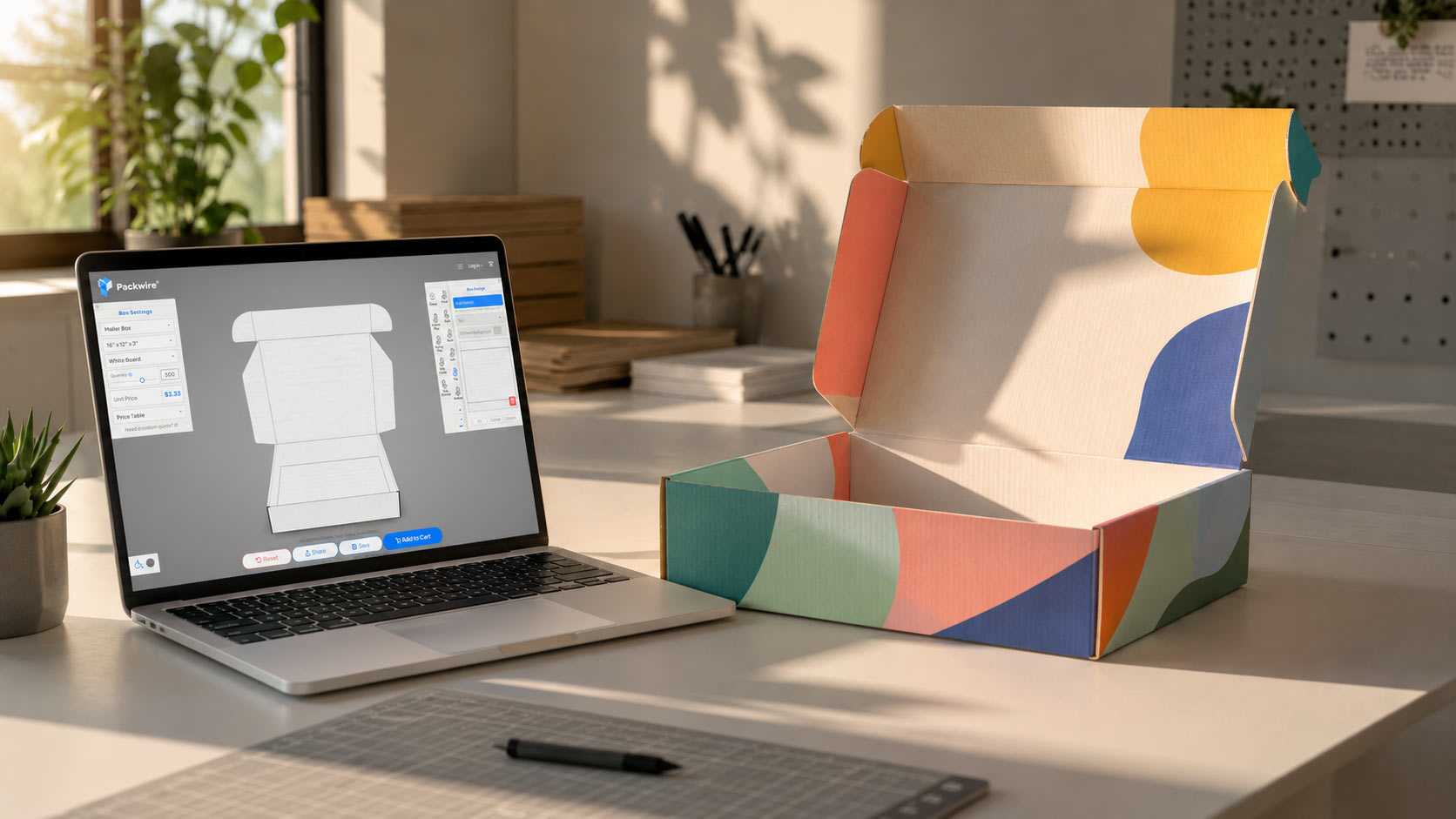
Using an online 3D packaging configurator, a founder with zero graphic design experience can upload their logo, drag and drop their brand colors, and instantly see a photorealistic 3D rendering of their box. The software automatically handles the bleed lines, the panel orientation, and the color conversion.
It provides B2C simplicity for a historically complex B2B product. You don't need to hire a $100-an-hour freelance designer just to prep your files for a vendor. You design it, you see it, and you order it—whether that is 10 boxes or 10,000.
Part 6: The Hidden Environmental ROI of Frictionless Packaging
Finally, we must address the massive environmental impact of traditional packaging procurement. The legacy B2B process is so rigid that companies actively hoard inventory just to avoid repeating the purchasing process.
The Carbon Footprint of Dead Inventory
When a company is forced into a high MOQ, they often buy 5,000 boxes even if their immediate campaign only requires 1,500. Months later, if the company updates its logo, changes a website URL, or reformulates a product, those extra 3,500 boxes become "Dead Inventory." They are sent straight to a landfill or recycling center before ever being used.
Frictionless, low quantity custom boxes allow brands to operate a "Just-In-Time" (JIT) inventory model. You order exactly what you need for this quarter. If your campaign pivots next month, your packaging pivots with it, eliminating dead inventory entirely.
Right-Sizing: Killing the Plastic Void-Fill
Because modern platforms use high-speed CAD cutting instead of expensive physical dies, brands are no longer forced to use a "standard size" box and stuff it full of bubble wrap.
You can easily adjust the dimensions of your box to perfectly hug your specific product. (Not sure what dimensions will work best for your products? Use our free Box Size Optimizer to calculate the exact fit). This practice, known as "right-sizing," eliminates the need for wasteful plastic void-fill. It also drastically optimizes your DIM weight and shipping ROI, because you are no longer paying carriers to transport empty air. True sustainability isn't just about recycled materials; it’s about smart, agile engineering.
Conclusion: Stop Fighting the Process
Whether you are a global brand manager trying to launch an influencer drop by Friday, or a startup founder trying to stretch your seed capital, your packaging supplier should be an accelerator, not a roadblock.
The search for low MOQ packaging is no longer just about avoiding high volume commitments. It is about demanding a better way to do business. By eliminating credit applications, bypassing the tooling trap with digital printing and CAD cutting, and replacing the "department bounce" with dedicated, end-to-end account managers, custom packaging can finally move at the speed of modern commerce.
Stop letting administrative red tape dictate your brand's physical presence. It is time to test small, validate fast, and experience truly frictionless packaging. Head over to our 3D configurator to design your next campaign instantly, or contact a dedicated Packwire account manager to bring your vision to life today.