 , fast delivery, and backed by our world-class customer service every step of the way.
  1-800-881-6093
 Back
Back
A/B Testing Your Brand: How to Use Low-Minimum Orders to Perfect Your Packaging
Launching a physical product in today's e-commerce landscape is a massive undertaking. You spend months perfecting your formulation, dialing in your supply chain, and obsessing over your brand identity. But when it comes to the final step of getting that product into your customer's hands, many founders rely on complete guesswork. They hop online, cross their fingers, and order thousands of units of a box design they sincerely hope will work.
This blind leap of faith is a massive financial risk. In the digital world, we would never launch a marketing campaign without testing it first. We test our Facebook ad copy, we test our landing page layouts, and we test our email subject lines. Why should your physical packaging be any different?
The old answer was that physical prototyping was simply too expensive. Legacy factories required massive financial commitments just to turn on the printing press. However, that landscape has shifted entirely. With the rise of low minimum order quantity packaging, you can now bring the agile testing mindset of a tech startup directly into your physical supply chain.
By utilizing platforms that allow for micro-runs, you can order a handful of custom printed boxes, test them in the real world, and gather actionable data before you scale your business. In this guide, we are going to break down exactly how you can use small packaging orders to optimize your custom unboxing experience, lower your return rates, and build a brand that customers actually want to share online.
The High Stakes of E-commerce Packaging
We are living in the unboxing era. The days of shipping a premium product in a blank, oversized, bubble-filled brown box are officially over. Social media platforms like TikTok and Instagram have turned packaging into a core marketing channel.
For modern brands, the packaging is the very first physical touchpoint a customer has with your business. It is the moment where your digital promises meet physical reality. If you deliver a stellar unboxing experience, you instantly increase the perceived value of your product. This leads to user-generated content, organic social media shares, and a significant boost in customer retention. When a customer films themselves opening your product and posts it online, they are doing your marketing for you.
But packaging is not just about aesthetics and viral moments. It has a gritty, functional reality. Your custom printed boxes must survive the brutal postal system. Packages are dropped, stacked, crushed, and left in the rain. If your box is beautiful but arrives completely flattened, your brand fails the test. You will be hit with expensive refunds, negative reviews, and a customer support nightmare.
This dual requirement of needing to look incredible while functioning as a protective fortress is exactly why guessing your packaging design is so dangerous. You need to know for a fact that your box will delight the customer and protect the product. The only way to know for sure is to test it.
What is Packaging A/B Testing?
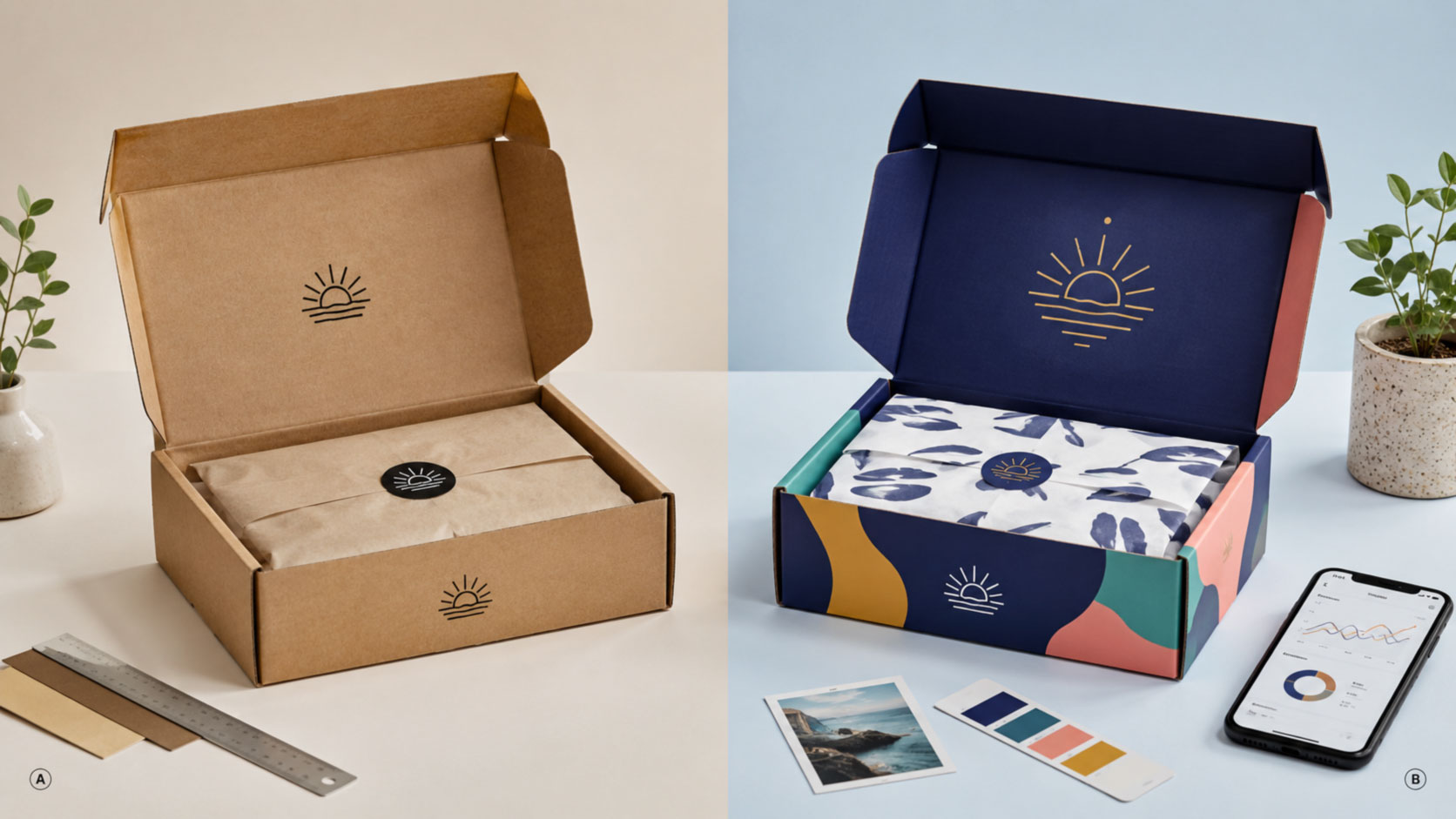
If you have ever run a digital business, you are likely familiar with A/B testing. It is the process of creating two variations of a digital asset (Variant A and Variant B) and showing them to different segments of your audience to see which one performs better.
Packaging A/B testing takes this exact same concept and applies it to the physical world. Instead of testing a website button color, you are testing structural designs, cardboard types, exterior artwork, or custom messaging. You design two different boxes, order a small batch of each, and ship them to real customers. You then track the results to see which box yielded the best outcome for your brand.
Physical testing takes slightly more time than digital testing, but it yields incredibly rich and qualitative data.
To understand why this is so revolutionary for bootstrapped founders, take a look at how this agile methodology compares to the traditional packaging industry.
| Feature | The Old Way (Traditional Packaging) | The New Way (Agile A/B Testing) |
|---|---|---|
| Initial Order Size | 3,000 to 5,000+ units minimum | As few as 10 to 500 units |
| Capital Commitment | High risk and highly capital intensive | Low risk and extremely budget-friendly |
| Design Flexibility | Locked in for months or even years | Easy to tweak, redesign, and pivot |
| Customer Feedback | Discovered way too late in the process | Integrated directly into the final design |
| Storage Needs | Requires massive warehouse space | Ships fast and takes up zero dead space |
The Danger of the Blind 5,000-Unit Run
Many new e-commerce founders fall into a classic trap. They find a manufacturer overseas or a legacy domestic printer that offers a fantastic per-unit price, but only if they order 5,000 units up front. Seduced by the cheap unit economics, the founder wires the money and waits eight weeks for a shipping container to arrive.
This decision almost always creates three massive problems for a growing brand.
1. Cash Flow Tie-Up
Ordering bulk packaging too early drains vital capital that a startup desperately needs for inventory, ad spend, and software tools. Tying up thousands of dollars in cardboard before you have even proven your product-market fit is a quick way to run out of runway.
2. The Warehouse Nightmare
Storing 5,000 boxes takes up a tremendous amount of physical space. If you are operating out of your garage or a small 3PL (third-party logistics) provider, you are going to pay a premium just to store flattened cardboard. Even worse, if your product size changes slightly in the next manufacturing run, or if you decide to rebrand your logo, all of that packaging instantly becomes dead weight. You will literally have to pay someone to recycle your wasted investment.
3. The Unforeseen Flaws
Let us look at a hypothetical scenario. An indie skincare brand orders thousands of sleek, glossy black boxes. They look incredible on a computer screen. But when they arrive at the customer's door, the glossy finish has collected hundreds of visible fingerprints and shipping scuffs. The premium vibe is completely ruined. A small test run of 20 boxes would have caught this exact issue, allowing the brand to pivot to a matte finish or a raw kraft material before scaling up.
What Variables Should You Test?
When you utilize low minimum order quantity packaging, the world is your oyster. But you should not just test things at random. You need a structured approach. Using a platform like the Packwire 3D design studio allows you to easily spin up different variations of your brand.
Here are the most important variables you should consider testing across different product lines.
Testing Aesthetic Variables
Design is subjective, but data is objective. You might love a certain color palette, but your customers might respond better to something else entirely.
- Minimalist vs. Maximalist: Does your audience prefer the raw, eco-friendly look of brown kraft cardboard stamped with a simple black logo? Or do they respond better to a vibrant, full-color box that screams for attention? You can easily test a muted design against a loud design.
- Interior Printing: This is a massive factor for the custom unboxing experience. You can test a box with a plain interior against a box that features a bright pop of interior color or a hidden message printed on the inside flap. You might find that interior printing increases your Instagram tags by 30 percent.
Testing Functional and Structural Variables
Sometimes the most important test is not about how the box looks, but how it functions in the real world.
- Box Style Comparison: You need to match the right box to the right job. You might test shipping your product in a Custom Mailer Box versus placing it inside a Folding Carton that goes into a poly mailer. Mailer boxes are the undisputed kings of e-commerce. They feature thick, durable E-flute corrugated cardboard and self-locking flaps that require zero packing tape. They are designed to survive the mail on their own. Folding cartons are thinner primary packaging designed for retail shelves and must be placed inside an outer mailer for protection. Testing both options will tell you which offers the best presentation and survival rate.
- Heavy Duty Needs: If you sell a heavy item like jarred candles or bottled beverages, you might need to test standard mailers against heavy-duty Shipping Boxes. Shipping boxes use thicker corrugated fluting to withstand serious weight.
- Premium Retail: If your product commands a high price point, you might want to test the ROI of upgrading to rigid, luxury packaging. Rigid Boxes offer an Apple-like unboxing feel. You can test if this premium upgrade justifies a higher retail price for your product.
- Right-Sizing: This is the ultimate cost-saving test. Instead of grabbing a stock box and stuffing it with excessive void fill, you can design a box perfectly tailored to your product's footprint. By eliminating empty space (also known as the air you are paying to ship), you reduce your need for packing materials and prevent items from shifting and breaking in transit. More importantly, reducing your box dimensions lowers your dimensional weight (DIM weight) for carriers like UPS and FedEx, or drops you into a cheaper cubic pricing tier for USPS. Before you run your physical A/B test, you can run your products through our Box Size Optimizer. Simply enter your product dimensions and preferred void fill (like corrugated inserts or kraft paper), and our 3D bin packing algorithm will test hundreds of arrangements to calculate the absolute smallest custom box you need. You can then order a small test run of those exact dimensions to prove the shipping savings in the real world.
Testing Marketing Variables
Your packaging is a physical billboard. You should test different marketing calls to action (CTAs) printed directly on the cardboard.
- QR Code Strategies: Print a QR code on the inside lid of Box A that links to a "10% off your next order" landing page. Print a different QR code on Box B that links directly to your product review page. Track the scans to see which CTA drives more value for your business.
- Social Handles: Test placing your TikTok and Instagram handles prominently on the outside of the box versus hiding them on the inside flap as a surprise.
Step-by-Step Guide to Executing a Packaging A/B Test
Now that you know the stakes and the variables, it is time to actually run your packaging beta test. Here is a clear, step-by-step methodology to get it done without disrupting your daily operations.
Step 1: Form a Clear Hypothesis
Do not test just for the sake of testing. You need a specific question you are trying to answer. A good hypothesis looks like this: "By adding an interior printed QR code offering a discount, we will increase our repeat customer purchase rate by 15 percent over a 30-day period." Another example might be: "By switching from a standard shipping box to a self-locking mailer box, we will reduce transit damage claims by half."
Step 2: Design Your Prototypes in 3D
Head over to the Packwire online design tool. This platform allows you to upload your artwork and see your box rendered in real-time 3D. You will create your control (Box A) and your experimental variant (Box B). Make sure you are only testing one major variable at a time. If you change the size, the color, and the material all at once, you will not know which change actually caused the result.
Step 3: Order the Minimums
This is where the magic of low minimum order quantity packaging comes into play. Instead of ordering thousands, order 30 to 50 units of Box A and 30 to 50 units of Box B. This keeps your upfront costs incredibly low and ensures you are not stuck with leftover inventory if a design fails.
Step 4: Segment Your Audience
You need to decide who is going to receive your test packaging. You have two reliable methods for this.
- Method 1 (The VIP Beta Group): Send the test boxes exclusively to your most loyal, returning customers. Send them an email beforehand explaining that they are part of an exclusive packaging beta test. People love being treated like insiders. In exchange for the product, ask them to fill out a detailed feedback survey.
- Method 2 (The Random Split): Send the boxes out randomly to brand new customers over a one-week period. Box A goes to the first 30 orders, and Box B goes to the next 30 orders. This provides unbiased data from people who have no prior relationship with your brand.
Step 5: Fulfill, Ship, and Monitor
Pack your products carefully and hand them off to your shipping carrier. Keep a close eye on the tracking numbers. The moment these boxes start landing on doorsteps, your data collection phase officially begins.
How to Measure the Results
Data is only useful if you actually track it. Once your custom printed boxes are in the wild, you need to monitor both the hard numbers and the human feedback to determine a winner.
Quantitative Data (The Hard Numbers)
These are the metrics you can track on a spreadsheet.
- Scan Rates: If you tested QR codes, jump into your analytics dashboard. Use UTM tracking parameters on your links so you can see exactly how many people scanned Box A versus Box B.
- Damage Rates: Monitor your customer support inbox closely. Did Box A result in three emails about dented corners, while Box B arrived perfectly pristine? Structural integrity is easy to measure by the volume of refund requests.
- Social Mentions: Search your brand hashtags on Instagram and TikTok. Count how many times each box design was featured in an organic unboxing video.
Qualitative Data (The Human Element)
Numbers tell you what happened, but human feedback tells you why it happened.
- Post-Purchase Surveys: Set up an automated email that goes out three days after the package is delivered. Ask simple, direct questions. "On a scale of 1 to 10, how excited were you when you opened your package?" and "Did the packaging feel premium to you?"
- Customer Support Interactions: Pay attention to the passive comments people make when they email you for other reasons. Customers will often throw in a quick line like, "By the way, I absolutely loved the cool colored box it came in!"
- Direct Outreach: Do not be afraid to pick up the phone. Call five customers who received Box A and five who received Box B. Ask them about their tactile experience. Did the box feel sturdy? Was it easy to open?
Once you have gathered all of this data, the winning design will usually be obvious. You will have actual proof that your new packaging drives engagement, protects your product, and satisfies your customers.
Stop Guessing and Start Scaling
Perfecting your e-commerce brand is a continuous process, not a one-time guess. By embracing the power of A/B testing, you can eliminate the financial anxiety of massive inventory commitments. You can tweak your colors, dial in your structural integrity, and craft a custom unboxing experience that turns one-time buyers into lifelong brand advocates.
Packwire was built from the ground up to support this exact agile methodology. With zero die-plate fees, incredibly low minimum order quantities, and an intuitive 3D design studio, prototyping your next big idea is completely risk-free. You have the freedom to experiment until you find the perfect fit.
Are you ready to run your very first packaging test and elevate your brand? Head over to the Packwire 3D Design Studio today to start building your custom prototypes.